OUTLINE

  • Introduction
    • Brief history of the mall, its rise and current fall.
  • The appearance and immediate success of shopping malls
    • Effects on the US
      • Cultural, social and economical impacts
    • Physical effects
      • Urban and spatial effects at different scales
        • Reshaping of cities, urban circulation
  • The typology of shopping malls
    • Architecture attributes
    • Define how it functions as a system
      • Human scale
      • Urban scale
    • Analyze its system in the city today
  • The fall of shopping malls
    • What happened?
      • Debate the product/cause of the downfall?
      • Consequences on society and cities.
    • Why are some failing and others thriving?
    • The spatial consequences of “dead malls”
  • Product of a cultural/urban system?
  • Cause of a cultural/urban system?
  • Are they a member of an ongoing system?
  • Is architecture responsible? What role/impacts has architecture had on this phenomenon? Can architecture react? If so, how?


Robert Venturi & Denise Scott Brown – Learning From Las Vegas

Michel Foucault – Of Other Spaces: Utopias & Heterotopias

Andres Lepik & Vera Simone Bader – World of Malls

Abstract

The appearance of shopping malls in the United States reshaped the country. An efficient model/typology was developed quickly, following the model of interior streets. The atmosphere was spacious, air conditioned and filled with light giving the sense of walking in a general city’s downtown. Not only did they reshape how Americans consume and socialize, they also reshaped cities and their relation with suburbs. Often in the outskirts of cities, shopping malls also transformed how Americans use transportation, enhancing and encouraging the use of cars.

In the mid nineteenth century, Paris underwent a monumental urban reform. Haussmann reshaped the city for the sake of modernity and revolutionized how the city functions in terms of circulation but more so socially and economically. Based on the model of the Haussmanization of Paris, shopping malls holds the notion of “to see and be seen”. However, instead of an outdoor public setting, it is enclosed in an artificial and materialistic environment. In order to function, both had to center around the capitalist value of consumption, however in the United States, it was mostly detached from the city center changing the system of cities and the urban envelop.

Originally designed by Austrian architect Victor Gruen in Edina Minnesota, the shopping mall was meant to be an efficient design with the aim to reduce sprawling but it has done the opposite.

From its appearance in the 1950s to the late 90s, shopping malls were booming and became a central element to people’s lifestyles. However, ever since the mid 2000s it has been on the decline. It is estimated that a fourth of shopping malls in the United States will be out of business by 2022. What happened to the effective model of shopping malls? What successful elements went missing?  Why and how is such a recent, successful typology already declining so rapidly?

I hope to study the phenomenon of shopping malls and its urban system as well as cultural. What makes the current ones successful? What are the different components to the system at an urban scale and its impact on the city and communities? What were the architectural consequences and what possibilities are available now?

I will be using works by Andres Lepik and Vera Simone Bader from World of Malls, and Chris van Uffelen. Furthermore, I will use essays of Robert Venturi, Leon van Schaik and more to strengthen my arguments.

Entry #3 | Hong Kong

As you first arrive to Hong Kong, it is undeniable that the density of population and buildings will impress you. Later, as you experience the streets, the efficiency of it all becomes overwhelming. Every corner is filled with surprises and unexpected architectural consequences. 

In Delirious New York, Rem Koolhaus uses New York city to describe chaos within the structure of street grids. “Since there is no hope that larger parts of the island can ever be dominated by a single client or architect,  each intention – each architectural ideology – has to be realized fully within the limitations of the block. Since Manhattan is finite, and the number of its block forever fixed, the city cannot grow in any conventional manner.”

Hong Kong deals with similar restrictions becoming wonderful opportunities. Especially for the island of Hong Kong, it is delimited by its sharp topography and even denser population. Moreover, due to the government-owned land, the cost of each property has become the most expensive in the world. Therefore, similar to New York, each intervention is precisely calculated with bold approaches for efficiency. In a near dystopian manner, housing complexes are stacked up, as an infinite extrusion from the ground. They are almost frightening but yet as you get use to them they become a symbol of human ambition and boldness.


Furthermore, some instances will surprise you when it comes to public spaces. For an unfamiliar reason, when I encountered public spaces such as basketball courts, soccer fields or large parks, I felt confused yet relieved at the same time. I believe it’s because I find it unusual to find such spaces in the middle of such verticality. Opposed to conventional cities, horizontality and openness become more unfamiliar than verticality. Putting aside the politics of the region, it is soothing to see a government spending so much on infrastructure and public spaces. Every park and playgrounds are well maintained and adequately used, in abundance. 

In other blocks, in the region of Mong Kok for example, the grid is tight and overwhelmingly dense. However, a few cracks within the block exist creating interesting spatial opportunities, from maze-like circulation paths to areas for small shops, smoking corners for restaurants as well as spaces to dry clothes for the locals.  

These tight alleys remind me of the back of a painting and its frame, the not so glamorous or attractive with the staples holding everything together. In Hong Kong, it’s the intricate system of pipes and fire exits, creating organized chaos on the walls. 


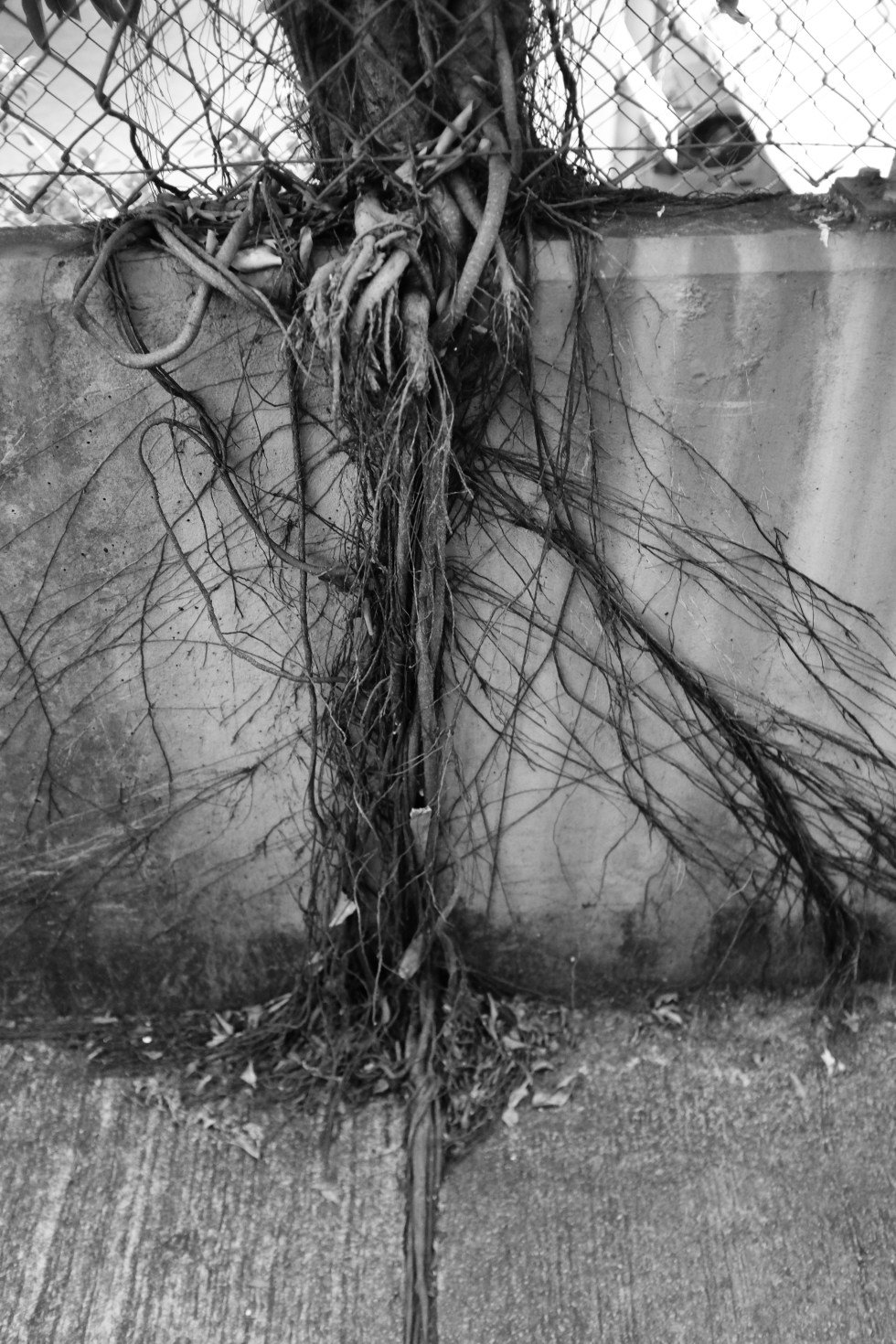
Furthermore, Koolhaus discusses the various aspects of Central Park. “Central Park is not only the major recreational facility of Manhattan but also the record of its progress: a taxidermic preservation of nature that exhibits forever the drama of culture outdistancing nature.”  I don’t believe there’s such a space in Hong Kong where the city has tried to control nature to such an extent. Hong Kong deals more with the outburst of nature. It applies at the scale of the mountain and steep hills of the city but also just within cracks through concrete. These situations add another layer of the complexity of the city and a fresh reminder of the unexpected consequences of architecture. 
 

tree through crack.jpg

Manifesto

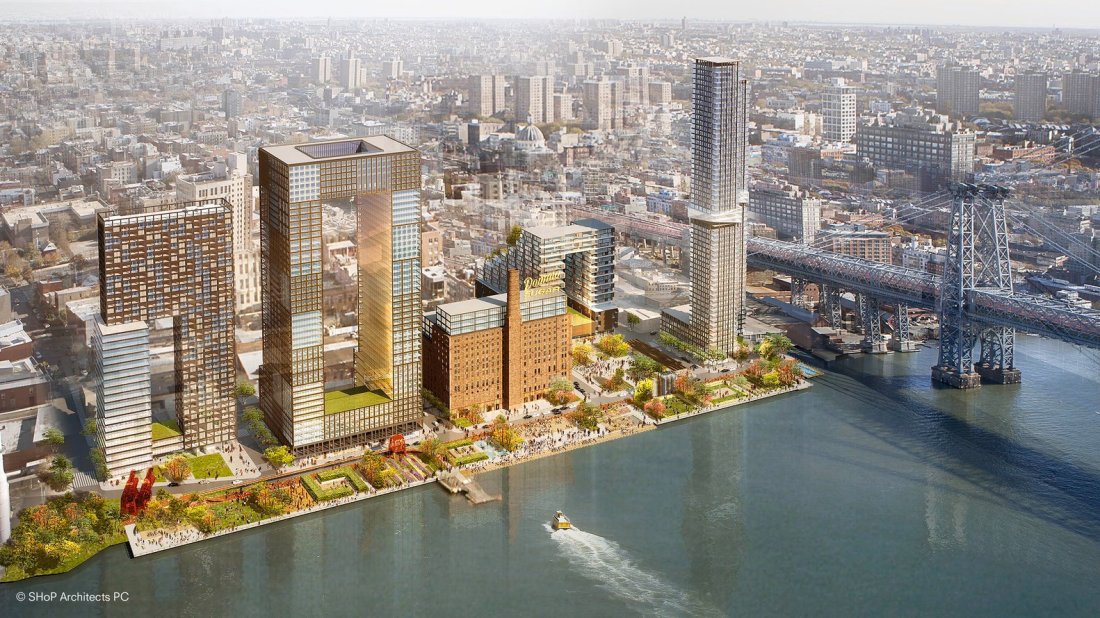
Architecture has always been a tool to generate money. However, today, it has become a representation of excess. Simple principles of architecture have seemed to disappear for the sake of developers and economic growth.  Aspects such as scale or specificity have been overthrown. Furthermore, there is this tendency to provide more amenities than needed in order to attract wider audiences rather than provide the proper necessities. Architecture seems to be focusing on the real estate rather than the individuals.  For instance, the new Domino Sugar Factory project led by SHoP Architects ignores the scale of the neighborhood and the impacts it will cause on the locals.

domino_birds-eye-view_reduced

The generating income has overthrown the sense of scale of projects. We are no longer designing for individuals but for developers. There is no longer the attention to neighbors, to our surroundings. Le Corbusier’s Second Point of architecture – roof gardens – has been absent in our buildings. Logistically they are not ideal but the essence of it, the relation with nature, has been ignored.

In some instances, the program of buildings has become excessive. Architects are now only working for developers whose focus is on attracting new clients and increase the income. The success of a building is often due to its marketing, its social media feed and no longer on the quality of the building, the attention to natural light or details. Architecture is lacking individuality. The overwhelming majority of architecture does not design for the individual, his comfort and quality of life.

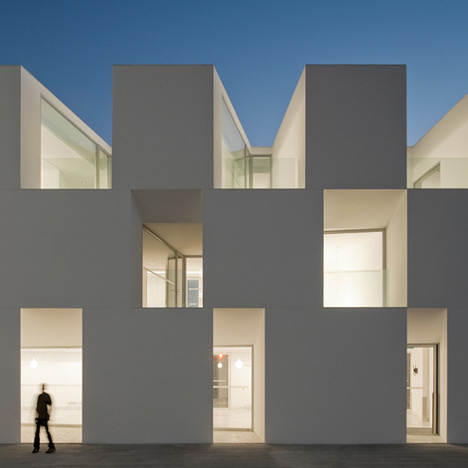
For instance, Aires Mateus’s houses for the elderly in Alcacer, Portugal are a successful project focus on the client’s experience and well-being.  “It is a program, somewhere in between a hotel and a hospital, that seeks to comprehend and reinterpret the combination social/private, answering to the needs of a social life, and at the same time of solitude. Independents unities aggregate into a unique body, whose design is expressive and clear.” The project interacts beautifully with light and its topography as it rises from the ground. It has created a strong community and comfort spaces for the elderly.

dzn_House-for-elderly-people-by-Aires-Mateus-Arquitectos-48

I understand the need of generating money through buildings. However, I believe we have pushed it too far in the world of real estate; we are designing less with care and more with greed. It is long overdue to take a stance and design with intent. Beauty is less and less in the vocabulary. Well proportioned architecture is less apparent. I am curious if we can find a formula to “re-design” the real estate approach to architecture. Architects should be working on finding the middle ground to keep generating money but also offer new options that deal with providing the proper needs to people rather than an abundance of superficial amenities. We need to step away from the obvious gentrification and design inclusive projects, design with scale and be aware of each other.


Entry #1

“The diagram, a complex notation that meditates between the traditions of the past and the possible future.” P. Eisenman


I’m interested in the notion of the changes of architecture over time. Changes in architecture apply at all scales, from changing your dining room table to the change of Louis XIV’s main entrance. The Cathedral of Notre Dame in Paris went from religious gatherings to a crowd of tourists. The architecture was used to gather the believers and attract more of them in order to gain power. Now it seems to be appreciated more as an architecture object.


We are not able to define how architecture will hold with society’s changes. The architectural elements are still present, studied by academia and appreciated by large groups but the intentions have evolved.


The diagram is interesting but only one can make them up with their imagination but the accuracy is uncertain. I don’t believe it’s a good or bad phenomenon but maybe an interesting thought for architects to sometime let go of all the will to control all aspects of architecture.


We are often taught to think about the possible future of our designs, however there’s great beauty in the unexpected outcomes, and they are individual to each one of us. For instance, the Museum of Modern Art of Sao Paulo, designed by Lina Bo Bardi, is monumental for its “absence of space” under the concrete span. It has become a space of gathering for the whole community, a market, a concert hall and a central point for the city.


Spaces and voids become personal. They change depending on the people, over time and by purpose. There are unexpected consequences. For instance, Versailles’s main attraction is the Castle. However, I have fonder memories of La Place du Marché. It becomes a big market on Sundays, but mostly a space of interaction. During the week it becomes a space of gathering, a spot for lunch breaks and kids to play around. I believe it is important to design thinking about the possible futures but also important to embrace that we might not be able to control everything and the beauty that comes with.